

Small businesses must determine which asbestos requirements apply before employees maintain, renovate, or demolish a workplace. Federal rules may come from OSHA, the EPA, or both, while state and local agencies can impose additional duties. The phrase asbestos regulations small business covers several overlapping responsibilities rather than one single compliance checklist.
How OSHA standards protect employees from asbestos exposure
OSHA standards address employee exposure to asbestos in general industry and construction settings. They establish requirements concerning exposure limits, regulated areas, training, protective equipment, work practices, communication, and, in qualifying circumstances, medical surveillance. The applicable standard depends largely on the work being performed and the way employees may encounter asbestos.
Employers should assess routine maintenance as well as specialized abatement. A worker who repairs walls, ceilings, pipes, or equipment may face a different set of controls from a crew removing asbestos-containing material during a major project.
When EPA NESHAP requirements apply to renovations and demolitions
EPA’s Asbestos National Emission Standard for Hazardous Air Pollutants, commonly called NESHAP, is intended to minimize asbestos release during covered facility renovations and demolitions. A renovation can include altering a facility component or removing regulated asbestos-containing material; demolition includes the wrecking or removal of load-supporting structural members and related handling operations. The EPA asbestos laws overview provides a useful starting point for understanding how NESHAP fits within the wider federal framework.
Owners and operators should not assume that a newer building is automatically outside the rules. The scope depends on the facility, the activity, the material involved, and applicable thresholds, notifications, and work practices.
How state and local rules can add stricter obligations
Federal compliance is only the baseline for many projects. States and local air-quality or occupational-safety agencies may require licensing, project notifications, specific surveys, training credentials, waste procedures, or approvals that go beyond federal requirements. Some jurisdictions also administer federal programs directly and use their own forms or deadlines.
Before work is scheduled, the business should identify the agency with authority over the site and confirm current requirements in writing. A state and federal asbestos law guide can help frame the questions, but it does not replace advice from the relevant regulator or a qualified professional.
Determining whether your business falls under general industry or construction requirements
General industry requirements commonly relate to employees who may encounter asbestos during ordinary workplace operations, housekeeping, or maintenance. Construction requirements generally become relevant when employees perform alteration, repair, renovation, demolition, removal, or other construction-related work that could disturb asbestos. The same business may therefore operate under different OSHA provisions at different times.
A written project description should identify the tasks, materials, locations, employees, and contractors involved. That record gives the employer a clearer basis for selecting controls and determining whether additional regulatory obligations apply.
Identify asbestos-containing materials before work begins
Asbestos cannot be reliably identified by sight alone. Building age can raise a question, but it cannot conclusively establish whether a material contains asbestos or whether it is safe to disturb. A careful identification process protects workers, occupants, schedules, and budgets.
Buildings, materials, and work activities that may present asbestos risks
Potential asbestos-containing materials may include flooring, ceiling products, insulation, roofing, siding, pipe coverings, cement products, joint compounds, mastics, and textured finishes. Materials can be present in older and newer facilities, and weather damage or deterioration can make previously stable materials more difficult to manage. The asbestos building information explains why condition and planned disturbance matter as much as presence.
Risk rises when work cuts, sands, drills, grinds, removes, breaks, or otherwise disturbs a suspect material. Routine visual inspection should therefore be paired with a review of planned tasks and access routes.
When to arrange an asbestos inspection or building survey
An inspection or survey should be arranged before renovation, demolition, significant repair, or maintenance that could disturb building materials. It may also be prudent after flooding, fire, impact, or other damage when materials have shifted or become friable. The survey should cover the areas and materials affected by the proposed work, not merely the room where the work begins.
The asbestos inspection and renovation FAQ offers useful context on surveys, renovations, demolitions, notifications, and waste. The business should still confirm the scope and method required by the authority governing its particular project.
Why only qualified professionals should sample suspect materials
Sampling can disturb material and release fibers if performed incorrectly. A qualified asbestos inspector or other properly trained professional can select representative samples, use appropriate precautions, document locations, and arrange analysis through a suitable laboratory. Employees should never be asked to collect samples simply because they are familiar with the building.
The final survey should identify sample locations, results, material condition, and limitations. Those details allow project planners to make decisions based on evidence rather than assumptions.
How to manage materials that are presumed to contain asbestos
When no reliable survey or laboratory result is available, the business should treat a suspect material as asbestos-containing for planning purposes. It should prevent unnecessary disturbance, notify affected employees and contractors, and revise the work plan before proceeding. Presumption is a protective interim approach, not permission for untrained workers to remove the material.
A clear designation also helps maintenance staff recognize boundaries and avoid accidental damage. If later testing changes the determination, the inventory and work instructions should be updated promptly.
Build an asbestos management and compliance program
A small business does not need a complicated bureaucracy to manage asbestos well, but it does need clear ownership and dependable records. The program should connect building information with everyday decisions about maintenance, repairs, contractors, and emergencies. Written procedures are especially valuable when the person who normally manages the facility is absent.
Assigning responsibility for asbestos safety in a small business
Management should appoint a competent coordinator with authority to stop work, obtain professional assistance, communicate hazards, and preserve records. The role may be assigned to a facilities manager, safety professional, or trained owner, provided the person has sufficient knowledge and access to qualified support.
Responsibilities should be stated in writing. Employees need to know whom to contact before disturbing a ceiling, wall, floor, insulation system, or other suspect material, and contractors need a single point of contact for site information.
Creating an inventory and documenting material conditions
The inventory should record known or presumed asbestos-containing materials, locations, quantities where available, condition, accessibility, survey dates, laboratory results, and planned controls. Photographs and floor plans can make the information more useful, especially in a building with several tenants or work areas.
The document should be updated after repairs, surveys, abatement, damage, or changes in occupancy. A stale inventory can be more dangerous than no inventory because it creates misplaced confidence.
Establishing procedures for maintenance, repairs, and accidental damage
A work-order process should require review of the asbestos inventory before maintenance begins. If a task could disturb a listed or suspect material, the coordinator should pause the job, define controls, and determine whether a qualified contractor or additional survey is needed. Staff should also know how to isolate an area without sweeping, vacuuming, or handling debris casually.
A practical procedure can be organized around a short sequence:
- Stop work and keep people away from the affected area.
- Prevent further disturbance without touching or sweeping debris.
- Notify the designated asbestos coordinator and building management.
- Arrange assessment, cleanup, and any required notifications through qualified professionals.
This sequence gives employees a safe first response while leaving sampling, cleanup, and clearance decisions to people with the appropriate training. It should be posted in maintenance instructions and included in contractor orientation.
Keeping required records, notifications, and exposure documentation
Records may include surveys, sample analyses, training documentation, employee exposure measurements, medical records where required, contractor qualifications, notifications, waste shipment records, and project closeout materials. Retention periods and access rules vary by record type and governing standard, so the coordinator should verify them rather than applying one blanket period.
A digital folder with controlled access can work for a small operation if documents are named consistently and backed up. Records should be retrievable by building, project, date, and responsible party.
Protect employees and occupants from asbestos exposure
Exposure control begins with avoiding disturbance whenever feasible. When work is necessary, the employer must use a planned combination of engineering controls, work practices, restricted access, communication, and personal protective equipment. Occupants and nearby workers also need protection, even when they are not part of the project crew.
Required training for employees who may encounter asbestos
Training should match the employee’s likely contact with asbestos. Maintenance staff who may encounter suspect materials need enough information to recognize hazards, follow stop-work procedures, understand labels and regulated areas, and report damage. Employees performing regulated work require the training specified by the applicable OSHA standard and state program.
Training records should identify the course, date, instructor or provider, attendees, and topics covered. Refresher training is useful when procedures change, a new material is identified, or an incident reveals a gap in understanding.
Regulated areas, warning signs, and access controls
A regulated area should be established wherever airborne asbestos exposure may exceed an applicable limit or where the standard requires restricted access. Barriers, warning signs, doors, and work scheduling can keep unauthorized people away from the operation. Signs should be understandable to employees, contractors, and occupants who may approach the area.
The boundary should reflect actual conditions and should be adjusted when work methods or monitoring results change. A locked door alone may not be adequate if dust can travel through shared ventilation or adjacent work paths.
Personal protective equipment and exposure-control practices
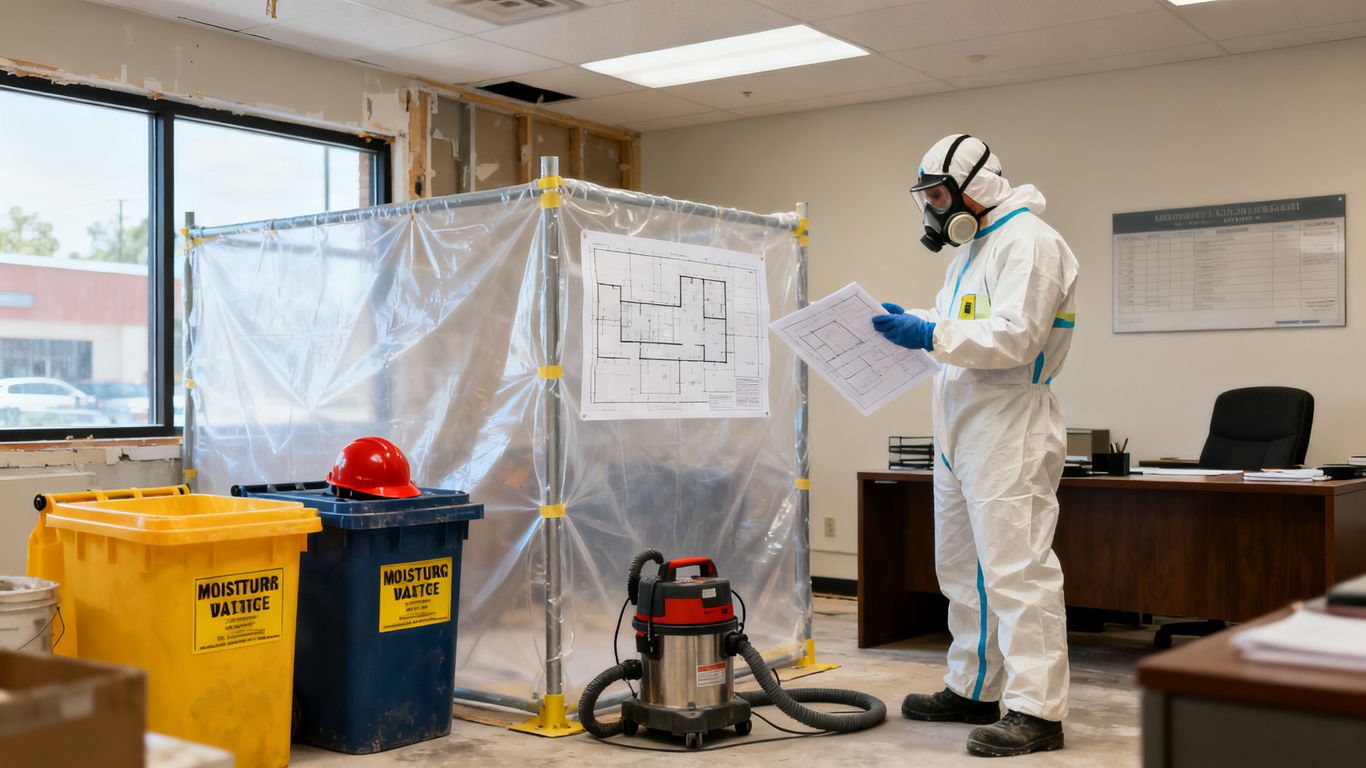
PPE is one part of a broader control plan, not a substitute for wet methods, local exhaust, enclosure, negative pressure, careful handling, and effective housekeeping where those controls apply. Respiratory protection must be selected, fitted, used, cleaned, and maintained under the employer’s respiratory protection program. Disposable or contaminated clothing must be handled so fibers are not carried into clean areas.
The work plan should address decontamination, changing areas, tools, ventilation, and cleanup. Employees need practical instruction and supervision so the written plan is reflected in what happens on the floor.
Air monitoring, medical surveillance, and OSHA recordkeeping
Air monitoring may be required to assess exposure, confirm the effectiveness of controls, or support decisions about respiratory protection and regulated areas. Medical surveillance can also apply to employees who perform qualifying work or are exposed at specified levels. Employers should use competent professionals to design monitoring and interpret results.
Exposure records, training records, and medical records must be maintained according to OSHA requirements and applicable privacy rules. The asbestos safety and health resource also highlights why cleanup and rebuilding after severe weather deserve particular caution when damaged building materials may release fibers.
Manage asbestos-related renovation and demolition work
Renovation and demolition create the greatest potential for uncontrolled disturbance because they change the building itself. The owner, general contractor, and asbestos contractor should coordinate before mobilization, not after materials have been opened. A written plan should connect survey findings, regulatory notifications, worker protection, occupant protection, and waste handling.
Planning projects around inspection and notification requirements
Project planning should begin with a review of the building survey and the exact scope of work. The team should identify regulated materials, affected components, sequencing, work boundaries, shutdowns, occupant relocation, and the agency notifications or permits that may be required. The NESHAP renovation guidance is a useful reference for understanding how renovation and demolition activities are characterized.
Schedules should allow time for professional inspection, laboratory analysis, notifications, contractor selection, containment setup, and final documentation. Treating those steps as a last-minute add-on can cause delays and unsafe changes in scope.
Classifying asbestos work under OSHA rules
OSHA classifies asbestos construction work by the type of activity and the likelihood of disturbing asbestos-containing material. Classification affects required methods, training, respiratory protection, regulated areas, and supervision. The employer should not rely on a project label such as “minor repair” without comparing the actual task with the applicable standard.
A qualified safety professional can help resolve uncertain cases and document the reasoning. If the scope expands after work starts, the classification and controls should be reassessed before the new activity proceeds.
Selecting licensed or qualified asbestos contractors
The business should verify the contractor’s licenses, training credentials, insurance, references, written work plan, and experience with the material and jurisdiction involved. It should also confirm who will supervise the work, conduct monitoring, manage waste, and communicate changes. Lowest price alone is a poor basis for selection when the consequences of inadequate controls can be severe.
Contract terms should require compliance with applicable federal, state, and local rules and should define documentation the contractor must provide. The owner remains responsible for choosing and overseeing its vendors, even when specialized work is delegated.
Verifying containment, waste handling, and project completion
Before work begins, the owner or designated representative should confirm that containment, decontamination, ventilation, access controls, and emergency contacts match the approved plan. During the project, inspections and monitoring should be documented, and deviations should be corrected promptly. Waste should remain controlled from removal through final disposal.
Closeout should include required monitoring or clearance documentation, waste records, updated building inventories, photographs where useful, and a record of unresolved restrictions. Those documents provide evidence that the space was returned to use under the conditions established by the project plan.
Handle asbestos waste, incidents, and ongoing compliance
Compliance continues after the last piece of material is removed. Waste, damaged materials, contractor records, and changing regulations can all create new exposure or liability if they are handled informally. A small business benefits from treating closeout and periodic review as ordinary parts of facility management.
Packaging, labeling, transporting, and disposing of asbestos waste
Asbestos waste should be packaged, labeled, handled, transported, and disposed of according to applicable EPA, state, local, and waste-transport requirements. The exact containers, labels, notifications, manifests, and disposal site criteria depend on the material and jurisdiction. Only authorized personnel and properly qualified contractors should perform these tasks.
The business should retain disposal documentation and reconcile it with the amount and type of waste generated. Missing records can make a completed project difficult to verify.
Responding to damaged materials, spills, and unexpected discoveries
When damaged material or unexpected suspect material is found, employees should stop work, limit access, and notify the coordinator. They should avoid sweeping, dry removal, compressed air, or other actions that could spread dust. A qualified professional should assess the condition, determine whether sampling or air monitoring is needed, and direct cleanup.
After the immediate response, management should identify why the material was missed and update the survey, inventory, training, or work-order process. A severe weather asbestos fact sheet is particularly relevant when storms or flooding damage older building components.
Auditing contractor performance and workplace controls
Periodic audits should compare actual practices with the contract, survey, work plan, training records, monitoring results, and waste documents. The reviewer should observe access controls, housekeeping, decontamination, PPE use, signage, and communication with occupants. Findings should be assigned to a responsible person with a completion date.
An audit is most useful when it leads to practical correction rather than paperwork alone. Repeated issues may indicate that the contractor needs closer supervision or that the business should reconsider its selection process.
Reviewing regulatory updates and state-specific requirements
Asbestos obligations can change through federal guidance, state rules, local agency procedures, and updates to licensing or notification systems. The coordinator should schedule periodic reviews and recheck requirements before every significant project. A federal and state asbestos requirements guide can help organize that review across jurisdictions.
The business should document the sources consulted, the date checked, and any resulting program changes. When the work involves unusual materials, uncertain classifications, or a high-risk condition, timely advice from a qualified asbestos professional and the relevant regulator is the safest path.