


As long as a company needs only one or two servers, hosting equipment in its own office may seem like the simplest option. The space is already available, the hardware has already been purchased, and adding another rack or a small server cabinet may appear to involve relatively little additional expense.
As the infrastructure grows, however, the economics change. Power consumption increases, more cooling capacity is required, and the company needs backup power, reliable Internet connectivity, physical security, and the ability to service equipment outside normal business hours.
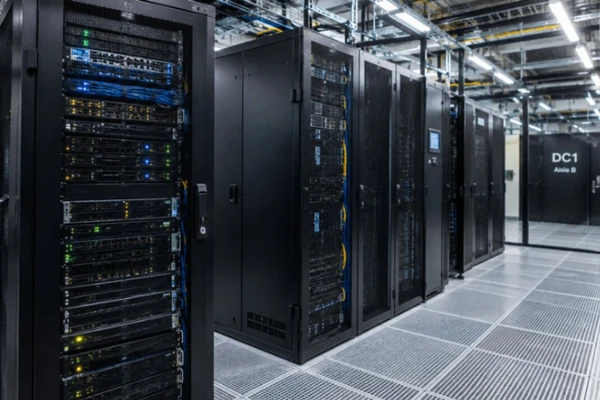
An alternative for companies considering colocation Deutschland is to retain ownership of their servers while hosting them in a professional data center and paying for rack space, power, connectivity, and additional services.
To determine which option is more cost-effective in Germany, it is not enough to compare the monthly price of a rack with the cost of office space. The full cost of the infrastructure required to operate the same server fleet needs to be calculated.
What a Company Pays for with On-Premise Infrastructure
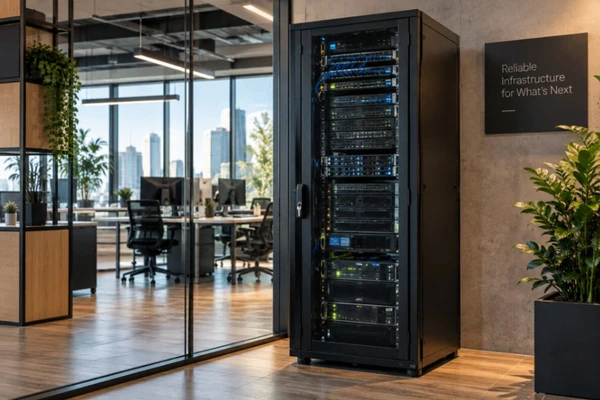
On-Premise means that equipment is hosted at the company’s own site – for example, in an office server room or a dedicated technical room. The physical space itself is only one component of the cost.
Operating servers requires:
- server racks;
- power supply and distribution;
- UPS systems;
- cooling;
- network equipment;
- Internet connectivity;
- access control and security systems;
- monitoring;
- fire protection;
- maintenance of all supporting infrastructure.
If the business requires high availability, the list becomes longer. Additional requirements may include redundant power circuits, additional UPS systems, multiple Internet connections, spare components, and incident response procedures. This is why the cost of On-Premise infrastructure begins to rise significantly as reliability requirements increase.
Electricity Costs Include More Than Server Power Consumption
If IT equipment consumes 5 kW, this does not mean that the facility only needs to pay for 5 kW of electricity. Additional power is required for cooling, UPS systems, and other supporting infrastructure. As a result, the actual power consumption of the entire server room is higher than the IT load.
In simplified terms:
Total facility power = IT equipment + cooling + power losses + supporting infrastructure.
The less efficient a small local server room is, the more significant this difference becomes.
In Germany, electricity costs make this factor particularly important for infrastructure that operates continuously. When comparing On-Premise infrastructure with Colocation, it is therefore necessary to understand what is included in the data center tariff and how power is billed: by allocated capacity, actual consumption, or another pricing model.
Cooling Becomes a Separate Infrastructure Requirement
Servers convert almost all of the electricity they consume into heat. As the server fleet grows, standard office ventilation is no longer sufficient. A cooling system designed for continuous 24/7 operation is required.
With On-Premise infrastructure, the company has to finance the installation, power consumption, and maintenance of this system itself. If high availability is required, another question arises: what happens if the cooling system fails?
For several critical servers, a single cooling unit becomes a single point of failure. A redundant system may therefore be required.
In Colocation, cooling is already part of the data center infrastructure. The customer pays for rack space and power according to the contract but does not need to build a separate heat removal system every time a new group of servers is added.
Backup Power Significantly Changes the Cost of On-Premise Infrastructure
A standard power grid does not provide the level of fault tolerance required for business-critical infrastructure. The minimum level of protection usually includes a UPS that allows systems to continue operating through a short outage or shut down correctly.
However, if a service needs to remain operational during an extended power outage, a UPS alone is not sufficient. The next level of redundancy is required – for example, generator infrastructure and an appropriate power switching system.
For a small company, building such a system solely for a few servers can be disproportionately expensive. A data center distributes the cost of its power infrastructure across a large number of customers. Colocation therefore provides access to redundant infrastructure without requiring the company to build it independently.
Connectivity: Office Internet and Data Center Networks Solve Different Problems
Another difference appears at the network level. For normal office operations, one or two Internet connections may be sufficient. For server infrastructure, however, nominal bandwidth is not the only consideration. Redundancy, routing, access to different carriers, and connection recovery times also matter.
With On-Premise infrastructure, carrier availability depends on the specific building. Connecting a second independent carrier may require additional work or may even be technically difficult.
A carrier-neutral data center typically provides more options. Customers can connect to multiple carriers, use cross-connects, and build redundant network routes.
In Germany, the concentration of network infrastructure in the Frankfurt metro area and access to major interconnection ecosystems, including DE-CIX, are particularly important. However, simply being located in a Frankfurt data center does not guarantee a better network. The connectivity of the specific facility and provider must still be evaluated.
How Much Does Space for an On-Premise Server Room Cost?
The cost of physical space is often underestimated because the server room is already located within an office the company is paying for. However, that space still has an opportunity cost.
As the infrastructure grows, more rack space is required, along with room for cooling and power equipment, safe maintenance aisles, and sometimes a separate area for storing spare components. If the company moves to a new office, server room requirements can begin to influence the choice of the building itself.
With Colocation, space can be purchased in much smaller increments – from a few rack units to part of a rack or a Full Rack. The company pays directly for the infrastructure capacity it needs rather than allocating additional office space to engineering systems.
Physical Security Also Has a Cost
A server room inside a secured office may be sufficient for some companies. However, as security requirements increase, the company needs to control who can access the hardware, log visits, and restrict access for employees who do not need to work with the equipment.
In a data center, these processes are part of the core infrastructure: physical perimeter security, access control, monitoring, and regulated access to technical areas.
With On-Premise infrastructure, a comparable level of protection has to be implemented independently. The comparison should therefore be made between equivalent security levels. A locked cabinet in an office will almost always be cheaper than professional Colocation – but these are not equivalent hosting conditions.
The Main Mistake Is Comparing Only Monthly Payments
The cost of Colocation is highly visible: the company regularly receives an invoice for rack space, power, connectivity, and additional services.
Some On-Premise expenses are hidden within other budgets. Electricity is included in utility costs, space is included in office rent, network maintenance falls under the IT budget, and employee time may not be allocated to the server room at all. As a result, On-Premise infrastructure can easily appear cheaper than it actually is.
For a proper comparison, two models can be used:
- TCO On-Premise = space + power + cooling + UPS + connectivity + security + maintenance + personnel + upgrades.
- TCO Colocation = rack space + power + connectivity + cross-connects + Remote Hands + additional services + equipment logistics.
The two scenarios can then be compared using the same number of servers, the same level of redundancy, and the same operating period.
Infrastructure Scale Changes the Result
For a single small server, building a complex TCO model may be unnecessary. If the equipment does not support critical external services, the existing office infrastructure may be entirely sufficient. But scaling from a few servers to half a rack or a Full Rack changes the requirements.
Power density and heat output increase. More network capacity is required. The consequences of infrastructure failure become more serious, while maintenance consumes more of the IT team’s time.
At this point, the company is effectively operating a small data center within its own business. The key question changes from “How much does it cost to put one more server here?” to “How much does it cost to maintain the complete environment required for dozens of servers?”
IT Team Time Is Also Part of Infrastructure Cost
On-Premise infrastructure requires more than hardware and engineering systems. Someone needs to monitor the server room, replace failed components, work with cabling, check power and network connections, and respond to physical incidents.
When there are only a few servers, these tasks may take only several hours per month and have little visible impact on the budget. As the infrastructure grows, however, they begin to consume a significant share of system and network administrators’ time.
Unplanned incidents are particularly expensive. If a drive, power supply, or network component fails at night or during the weekend, a technician needs physical access to the equipment.
With Colocation, some of these operations can be delegated to Remote Hands. A data center engineer can check a connection, replace a pre-positioned component, reboot equipment, or perform other physical tasks according to instructions.
Remote Hands is charged separately, but it eliminates the need to maintain a permanent in-house team presence close to the servers.
Colocation Allows Infrastructure to Scale Gradually
Another advantage of the model becomes apparent as the server fleet grows. A company does not necessarily need to rent an entire rack from the beginning. Deployment can start with a few rack units and later expand to a ¼ Rack, ½ Rack, or Full Rack.
With On-Premise infrastructure, each stage of growth has to be evaluated against the limitations of the existing site. Is there enough electrical capacity for another five servers? Can the cooling system handle them? Is there enough rack space? Can Internet bandwidth be increased? Will the UPS need to be upgraded?
As a result, the next server may be inexpensive by itself, but installing it can trigger an expensive upgrade of the surrounding infrastructure. In Colocation, much of this infrastructure is already in place, and growth is more often a matter of purchasing additional rack and power capacity.
Downtime Is Another Part of TCO
A cost comparison is incomplete without considering the cost of downtime. If servers are used only for non-critical internal tasks, several hours of downtime may have little financial impact. For ecommerce, SaaS, customer platforms, and other production systems, the situation is different.
The cost of downtime may include lost sales, service unavailability for customers, SLA violations, and the working time of specialists involved in recovery.
In simplified terms:
Cost of downtime = lost business + recovery costs + customer impact.
This does not mean that Colocation eliminates outages. Failures can occur in any infrastructure. The difference is how much the company itself needs to invest to provide a comparable level of power, cooling, and connectivity redundancy. A proper comparison is therefore not simply between On-Premise and Colocation, but between two scenarios with equivalent availability requirements.
When On-Premise Remains a Rational Choice
Moving equipment to a data center is not necessary for every growing company. On-Premise infrastructure may be justified when there are only a few servers, the existing facility already meets the requirements, the workload does not require high power density, and downtime does not create a significant business risk.
Local hosting is also convenient when equipment needs to be physically close to production systems, laboratory equipment, or other infrastructure requiring a local low-latency connection.
An in-house server room can also make economic sense at a sufficiently large scale if the company already has a suitable facility, engineering infrastructure, and a team capable of operating it.
Colocation is therefore not a universal replacement for On-Premise infrastructure. Its economic benefit depends on the infrastructure the company would otherwise need to build and operate itself.
When Colocation Becomes More Cost-Effective
The case for Colocation becomes stronger as infrastructure requirements increase. The model is particularly attractive when a company needs more rack space and power, requires redundant power and cooling, needs multiple carriers or high network capacity, and expects its equipment to operate around the clock.
Another indicator is when the company’s own facility is approaching its capacity limits. If the next stage of growth requires installing a new UPS, expanding cooling, rebuilding the server room, or upgrading the incoming power supply, the cost of such a project should be compared with moving the servers to a data center.
Hybrid Infrastructure Means You Do Not Have to Move Everything at Once
The choice does not have to involve completely abandoning an in-house server room.
Some equipment can remain On-Premise while production infrastructure is moved to Colocation. For example, systems that need to remain close to the office or production environment can stay local, while external services and business-critical servers are hosted in a data center.
Another option is to combine On-Premise infrastructure with Colocation and Public Cloud. Permanent physical capacity can run on company-owned or colocated servers, while Cloud is used for selected managed services, development, or temporary workloads. This allows the company to migrate infrastructure gradually and choose the environment according to the requirements of each workload.
Colocation or On-Premise: What Should a Growing IT Team Choose?
At a small scale, On-Premise infrastructure can remain a simple and cost-effective solution. The company uses existing space and does not pay a separate monthly Colocation bill.
However, as the server fleet grows, the cost becomes increasingly determined not by the servers themselves but by the infrastructure around them: power, cooling, networking, redundancy, security, and staff time.
Colocation changes this model. The company retains control and ownership of its hardware but no longer needs to build and maintain a significant part of the physical environment itself.
For a growing IT team, the key question is not “How much does a rack in a data center cost?” but “How much will it cost us to provide comparable conditions for our own servers ourselves over the next three to five years?”
That comparison reveals the real cost difference between Colocation and On-Premise.